


There is a manuscript in the British Library with two famous illuminations of early English queens. The images below do not really do them justice. What looks like a brownish colour is in fact brilliant gold leaf; the blue saturation is exemplary and the shading in the rest of the colours is very nuanced. Within the context of the manuscript, there is no doubt as to who these two women are meant to be. I say ‘meant to be’ because they anachronisms. The codex in question, British Library Cotton MS Claudius B VI is 13th-century compilation of charters – a cartulary – for Abingdon Abbey. The queens are included because the lands they granted in the charters in question came into the ownership of the abbey.

The second of the images (in order of where they appear on the page) is of Æthelflæd, Lady of the Mercians. We know this because it comes under a rubric ‘carta Elfledae regine’, while the accompanying text is of the charter known as S225. In this charter, Æthelflæd gives her minister, Eadric, permission to purchase 10 hides at Farnborough. The reason he needs permission for the purchase is that the original charter, given to the seller’s ancestors by King Offa, was destroyed in a fire. We could say a lot about this charter: around the idea of Mercian land ownership, or the transition of authority from Offa in the late-eighth-century through to Æthelflæd in the early-tenth, or the fact that this charter only survives in Cotton MS Claudius B VI, or that it is one of only two extant charters issued by Æthelflæd herself. But that’s not our task here. Our task is to correct an error of identity that has permeated the internet from Wikipedia, to Alamy, Medievalists.net, the Rex Factor podcast and everything in between: that of the other queen who appears on the page.
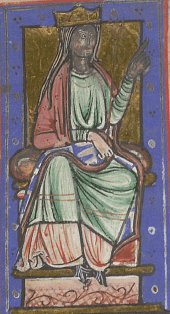
This image is not, as is often asserted, of Ealhswith, the consort of King Alfred the Great. Quite when this misidentification came into being is not clear. I can find no scholarly sources that introduce this error, and the only transcription of the cartulary, that by Joseph Stevenson from 1858, makes no such claim. The image comes under the rubric ‘carta Aðelswið regine’, and the text is of the charter known as S1201. This was issued in 868 by a woman who identifies herself as ‘Ego Æðelswið regina Deo largiente Merciorum’ (I, Æthelswith, through the generosity of God, queen of the Mercians). Ealhswith was never queen of the Mercians. However, Alfred’s sister Æthelswith was, having married the Mercian King Burgred in the 850s. In truth, there’s no real mystery here. The identity of the person in this miniature has long been known to those familiar with manuscript. If there is a mystery, it is quite how the illustration came to be identified with Ealhswith, though it may simply boil down to the similarities between, and the unusual nature (to modern ears), of both of the royal women’s names.
So then, all that remains is for someone to go around and tidy up all of the misidentifications across the internet, preferably starting with Ealhswith and Æthelswith‘s Wikipedia pages…
Categories: History & Analysis, Manuscript Archives
 The Postgrad Chronicles